Thomas algorithm
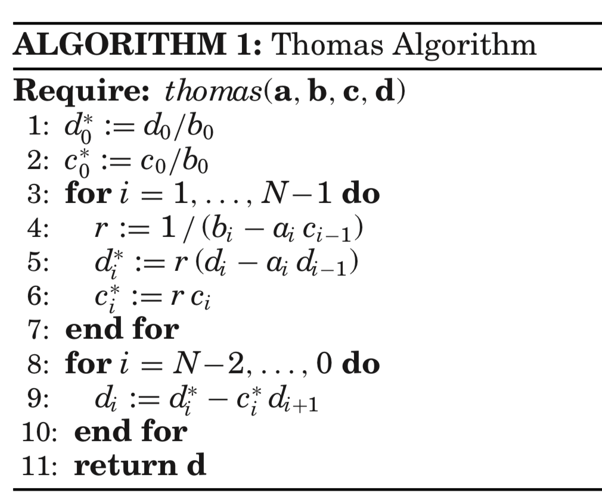
The Thomas algorithm is the best-known sequential tridiagonal matrix algorhtm (TDMA) that is commonly used to obtain the solution of a tridiagonal system. It is a special form of the Gaussian elimination algorithm for the diaonally dominant or symmetric positive definite (SPD) tridiagonal matrix. This algorithm has the ideal compuational complexity, \(O(N)\). It greatly reduced to \(O(N)\) instead of \(O(N^3)\) for the Gauss elimination.
$$ \begin{pmatrix} b_0 & c_0 & 0 & 0 & 0 & \cdots &0 \\ a_1 & b_1 & c_1 & 0 & 0 & \cdots &0 \\ 0 & a_2 & b_2 & c_2 & 0 & \cdots &0 \\ 0 & 0 & a_3 & b_3 & c_3 & \cdots &0 \\ \vdots & \vdots & \vdots & \vdots & \vdots & \ddots & \vdots \\ 0 & 0 & 0 & 0 & 0 & \cdots & c_{n-1} \\ 0 & 0 & 0 & 0 & 0 & \cdots & b_n \end{pmatrix} \begin{pmatrix} x_0 \\ x_1 \\ x_2 \\ x_3 \\ \vdots \\ x_{n-2} \\ x_{n-1} \end{pmatrix} \begin{pmatrix} d_0 \\ d_1 \\ d_2 \\ d_3 \\ \vdots \\ d_{n-2} \\ d_{n-1} \end{pmatrix}, $$
the Gaussian elimination procedure can be simplified as follows:
Forward elimination
$$ c'_i = \begin{cases} \frac{c_i}{b_i}, & i=0\ \frac{c_i}{b_i-a_i c' _{i-1}}, & i=1, 2, \cdots, n-2\ \end{cases} $$ $$ d'_i = \begin{cases} \frac{d_i}{b_i}, & i=0\ \frac{d_i - a_i d'_{i-1}}{b_i-a_i c' _{i-1}}, & i=1, 2, \cdots, n-1\ \end{cases} $$
Backward elimination
$$ \begin{aligned} x_{n-1} &= {d}'_{n-1}, \\ x_{i} &= {d}'_{i} - c'_{i}x_{i+1}, \quad i = n-2, n-3, \cdots, 1, 0 \end{aligned} $$
However, the Thomas algorithm for a tridiagonal system cannot be made parallel due to its sequential process during both elimination and substitution.
Modified Thomas algorithm
The divide-and-conquer method of
Laszlo et al.(2016) is used to solve partitioned tridiagonal systems of equations in the distributed memory system.
Divide-and-conquer methods
- Divide-and-condquer methods have been utilized to solve many tridiagonal systems in a parallel manner.
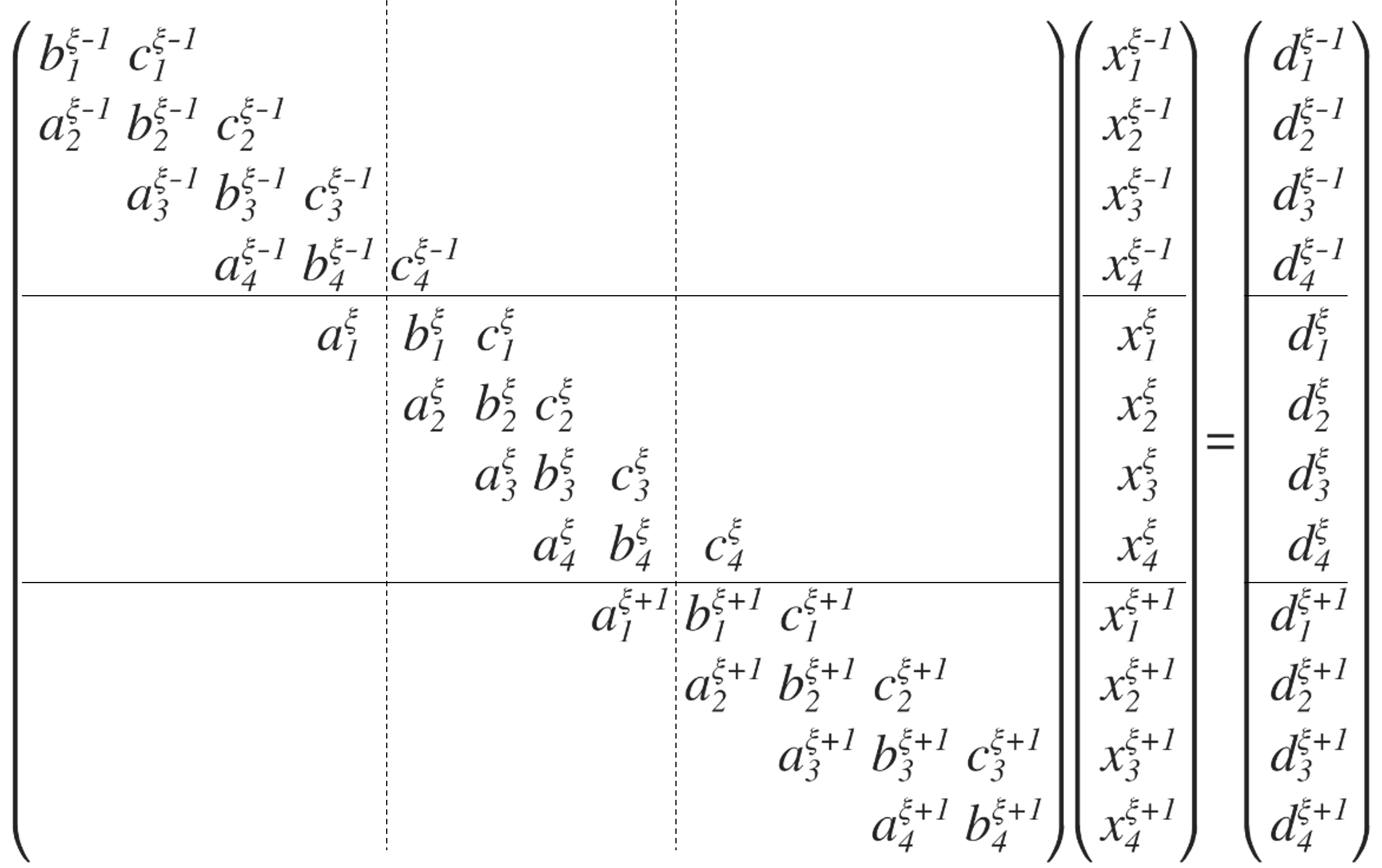
- Large tridiagonal system is transformed into a reduced tridiagonal system through partial reduction in each partitioned sub-matrix, which are divided in computing cores.
- The soultion is the obtained by solving the reduced tridiagonal system and updating the remaining unknowns in the partitioned sub-matrices.
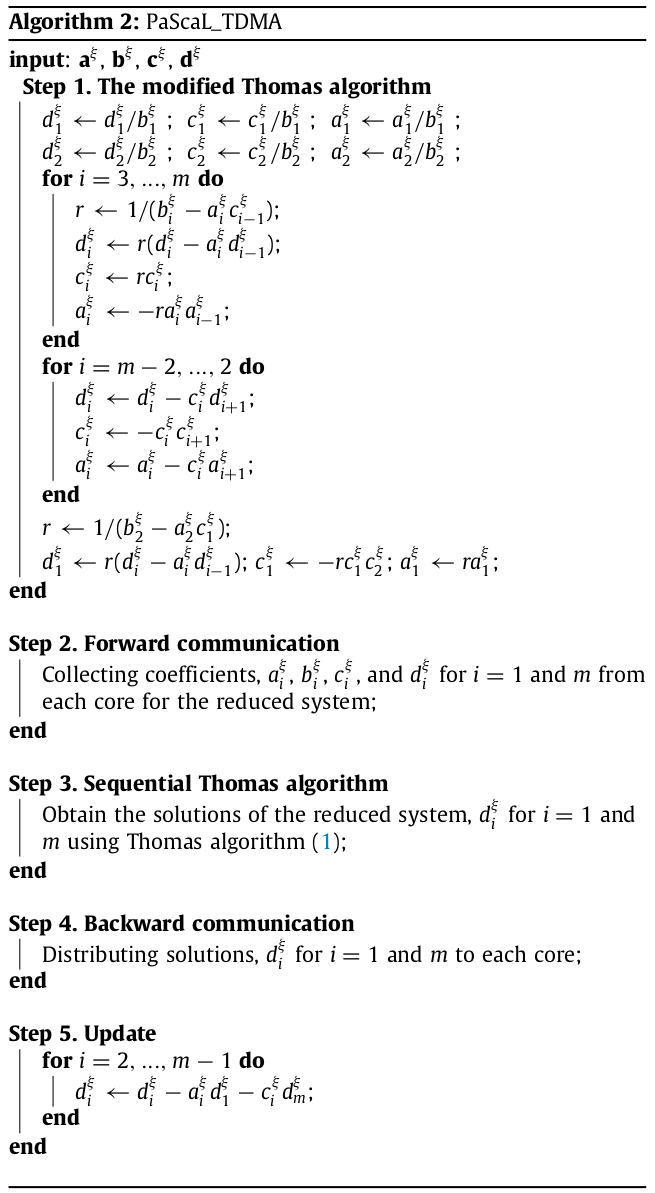
PaScaL_TDMA algorithm
- Transforming the partitioned sub-matrices in the tridiagonal systems into modified sub-matrices
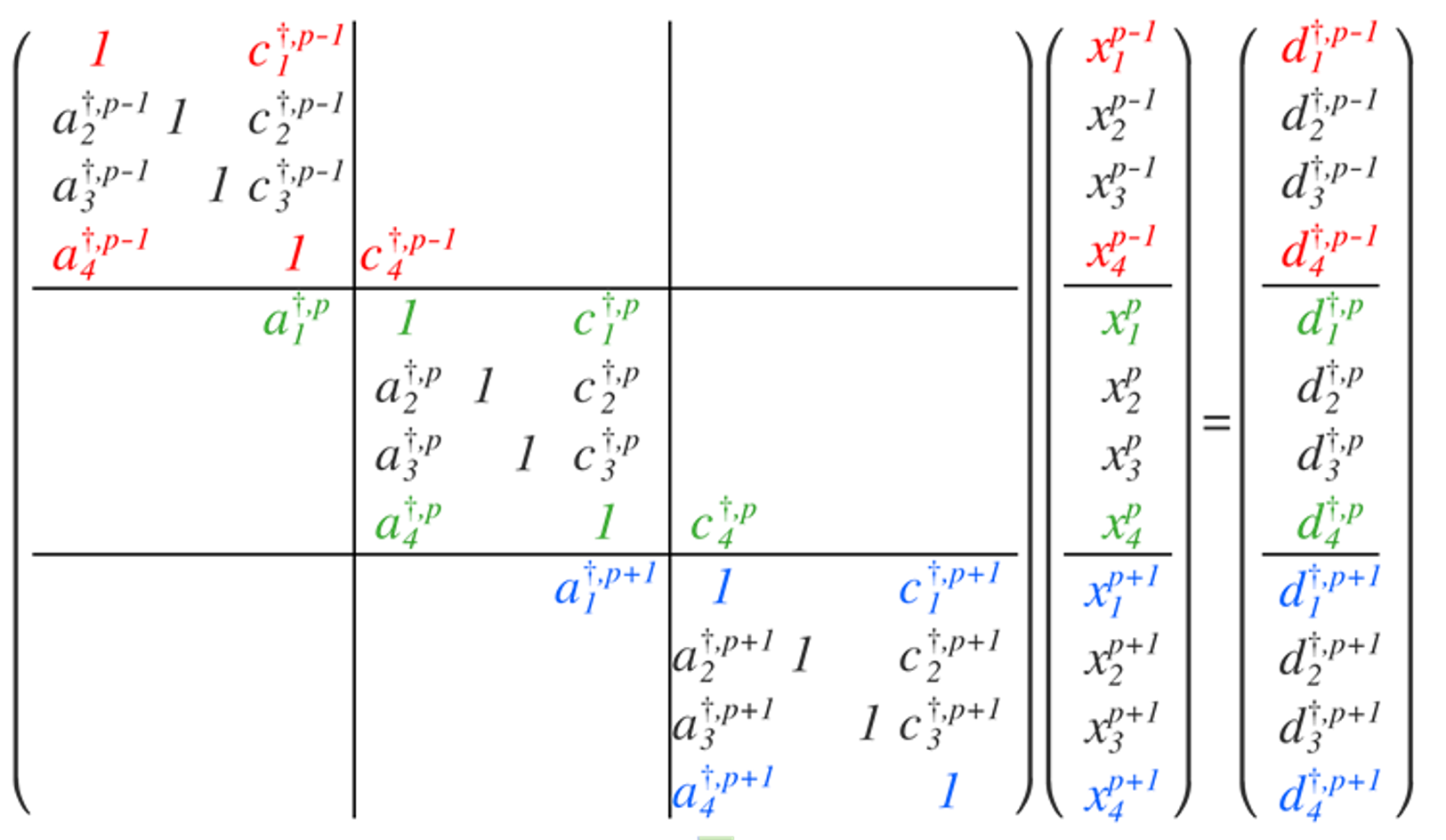
- Constructing reduced tridiagonal systems from the modified sub-matrices
- Solving the reduced tridiagonal systems
- Distributing the solution of reduced tridiagonal system
- Updating the other unknowns
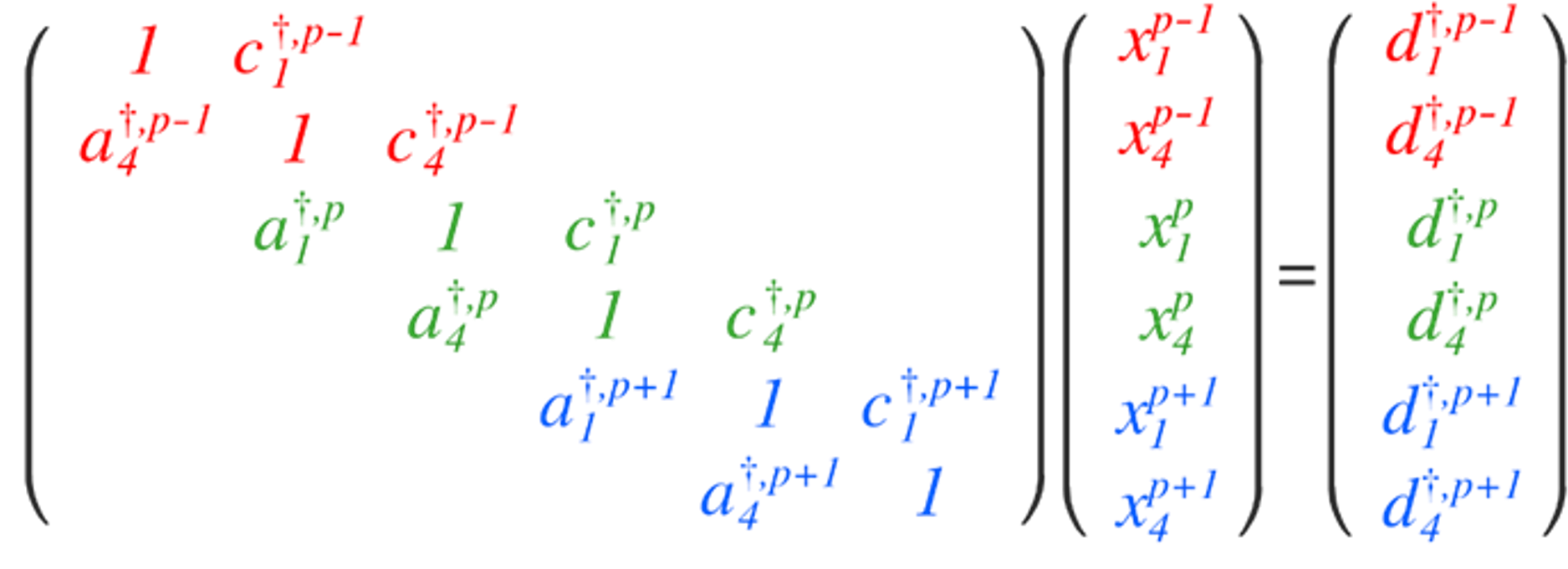
Step 1. Each computing core transforms the partitioned sub-matrices in the tridiagonal systems of equations into the modified forms by applying the modified Thomas algorithm of
Laszlo et al.(2016).
Step 2. The reduced tridiagonal systems are contributed by collecting the first and last row.
- Data communication is still required
- The amount of communication required is remarkably reduced
- Each core needs to communicate only for two rows
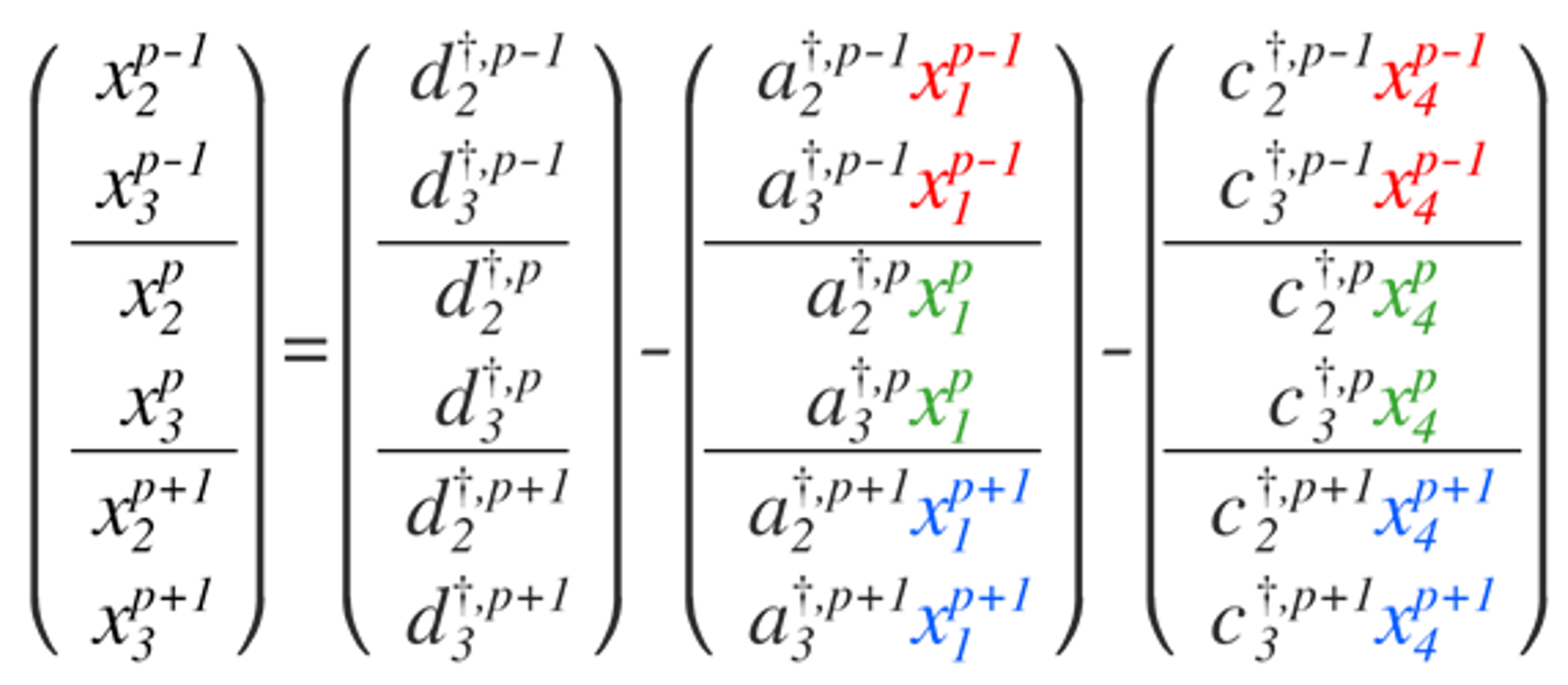
Step 3. The reduced tridiagonal systems contributed in upper equation are solved by applying the Thomas algorithm.
Step 4. Distributing the solution of reduced tridiagonal system.
Step 5. The remaining unknowns of the modified sub-matrices in Step 1 are solved in each computing core with the solutions obtained in Step 3 and Step 4.
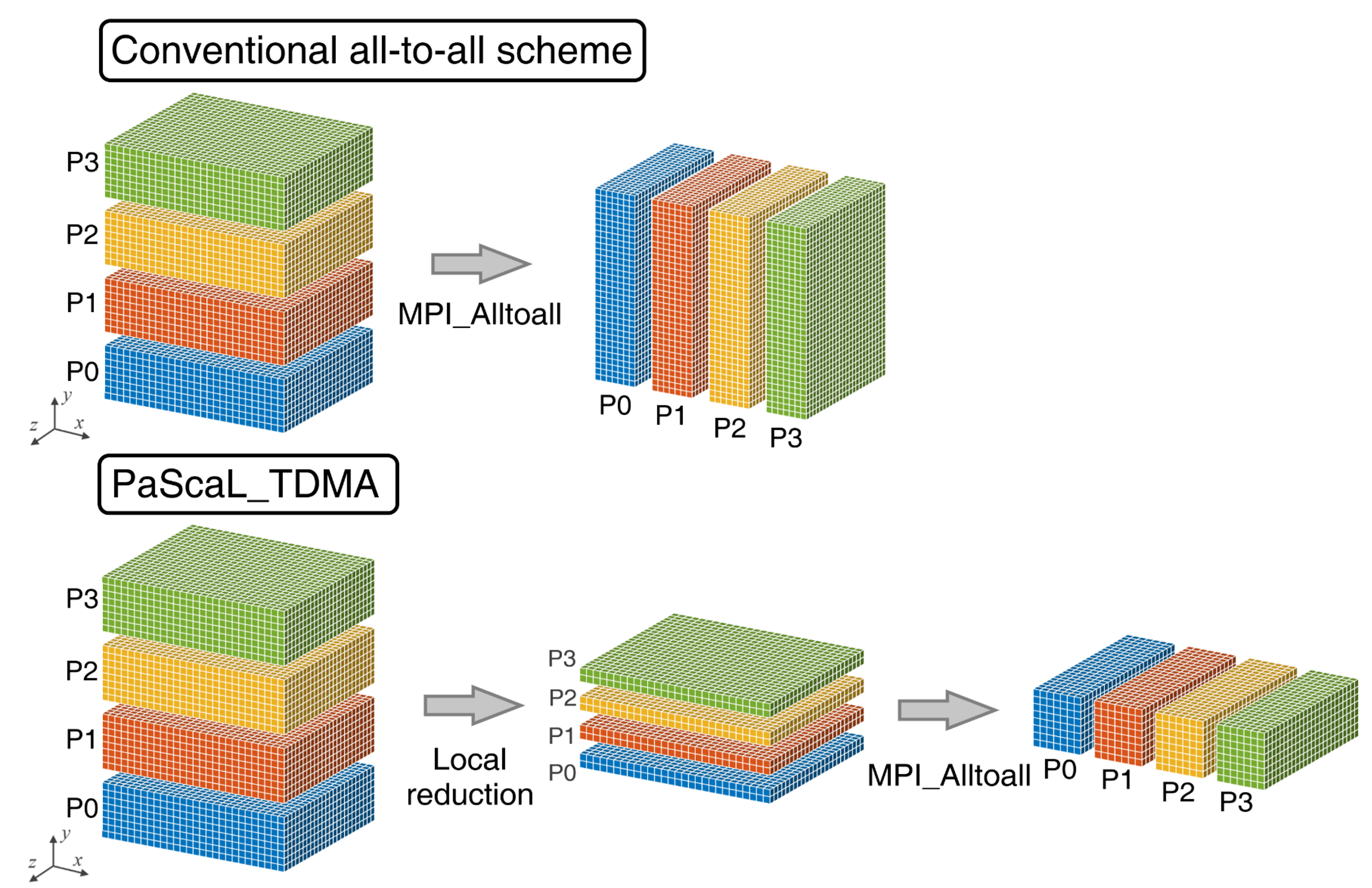
All-to-all communication
- The newly designed communication scheme based on MPI Alltoallw acclerates to collect the rows and construct the reduced tridiagonal systems.

 1.9.5
1.9.5